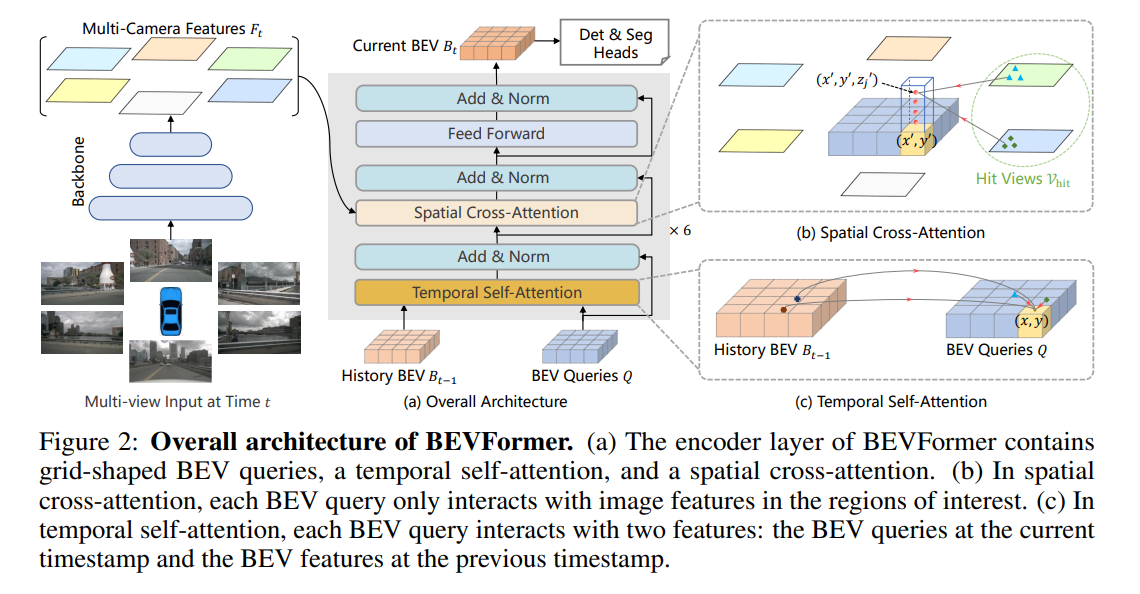
BEVFormer-tiny (R50) is a highly efficient autonomous driving model designed for multi-camera 3D object detection on resource-constrained edge platforms. Built upon the classic ResNet-50 backbone, it utilizes unique spatio-temporal attention mechanisms to seamlessly transform multi-view 2D camera feeds into a unified Bird's-Eye-View (BEV) feature space. As a lightweight "Tiny" variant, it optimizes transformer layers and grid resolutions to drastically reduce memory footprint and latency, while fully preserving its robust capabilities in velocity estimation and temporal trajectory tracking for dynamic objects. Thanks to its exceptional performance-to-power ratio, BEVFormer-tiny has become an industry benchmark for implementing high-precision 3D spatial perception and Vehicle-to-Everything (V2X) coordination on low-power automotive chips and roadside computing units (RSCUs).
Source model
- Input shape: [[1,6,3,480,800]]
- Number of parameters: 33.7M
- Model size: 128.5 FP32
- Output shape: boxes [[300,9]], scores [[300]], labels [[300]]
Source model repository: bevformer
Model Farm provides optimized model resources and test code, which can be obtained through the following two methods:
Obtain via Model Farm page: Click Models & Test Code in the Performance Reference section on the right to obtain model resources and code packages.
Obtain via command line (Recommand): Users with APLUX development boards can obtain model resources and code packages through the built-in MMS tool.
# Search Models
mms list [model name]

# Get Models
mms get -m [model name] -p [precision] -c [soc] -b [backend] -d [file path]
For MMS usage, please refer to: MMS Usage & Access to Preview Models
When the user has fine-tuned the source model, the model conversion process must be performed again.
Users can refer to either of the following two methods to complete the model conversion:
Using AIMO for model conversion: Click Model Conversion Reference in the Performance Reference section on the right to view the conversion steps.
Using Qualcomm QNN for model conversion: Please refer to the Qualcomm QNN Documentation.
The model performance benchmarks and example code provided by Model Farm are all implemented based on the APLUX AidLite SDK.
For models in .bin format, you can use either of the following two inference engines to run inference on Qualcomm chips:
Inference using APLUX AidLite: please refer to the APLUX AidLite Developer Documentation
Inference using Qualcomm QNN: Please refer to the Qualcomm QNN Documentation
Inference Example Code
The inference example code is implemented using the AidLite SDK.
Click Model & Code to download the model files and the inference code package. The file structure is as follows:
/{model_name}_{SoC Name}_{Precision}

    |__ models # folder where model files are stored

    |__ code # aidlite python model inference example

        |__ python # aidlite python model inference example

        |__ cpp # aidlite cpp model inference example

        |__ README.md